This chapter presents Steadman’s
crucial findings in relation to Vermeer’s use of the camera obscura.
The perspective reconstruction's of Chapter 5 make it possible
to plot the positions in space of the theoretical viewpoints of
the ten relevant paintings. Everything that can be seen in each
picture is contained in a ‘visual pyramid’ — a pyramid on its
side, whose apex is at the viewpoint. Supposing that the sloping
edge-lines of this pyramid are extended back, through the viewpoint,
to meet the room’s back wall. They define a rectangle on that
wall. In six out of the ten cases this rectangle is the exact
size of Vermeer’s painting. The geometry is that of a booth-type
camera, with its lens at the painting’s viewpoint and the screen
on the wall. The image is the same size as Vermeer’s canvas, because
Vermeer has traced it. The chapter discusses the — by no means
insuperable — problems posed by the fact that this image would
have been upside-down, and might have been reversed left-to-right.
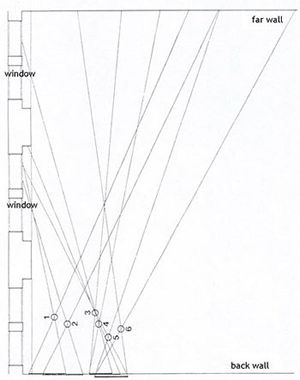
[Left below] Plan of the room
with viewpoints marked for six paintings: 1.‘Girl with a Wineglass’,
2. ‘The Glass of Wine’, 3.‘Lady Writing a Letter, with her Maid’,
4. ‘Lady Standing at the Virginals’, 5.‘The Music Lesson’, 6.
‘The Concert’. The diagonal lines mark the ‘visual pyramid’ defining
the extent of what is visible in each picture.
[Right below] Possible arrangement
for Vermeer's camera obscura.